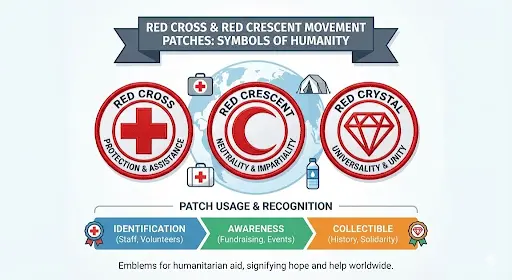
If you’re ordering patches for the Red Cross and Red Crescent Movement, you’re not ordering “merch”.
You’re ordering an emblem that can protect lives, signal neutrality, and instantly tell people, “Medical help is here.” That’s a different job than a normal logo patch. It comes with rules, approvals, and a level of accuracy that leaves zero room for “close enough”.
This guide covers what Red Cross and Red Crescent Movement Patches are used for, who can legally use them, and how to spec patches that stay readable in real conditions, from field response to clinical uniforms.
What Makes Red Cross And Red Crescent Movement Patches Different
The emblem is protected by law, not treated like a brand mark
The red cross, red crescent, and red crystal are protective emblems recognised under the Geneva Conventions. They are not decorative symbols and they are not a religious symbol.
In the UK, misuse is a legal issue, not a “branding preference”. Under the Geneva Conventions Act 1957 (as amended), using the emblem without proper authority is unlawful, and civilian use outside the British Red Cross is described as misuse.
That’s why a professional supplier will ask the right questions before producing these patches.
Protective use vs indicative use
There are two broad uses recognised in international humanitarian law:
- Protective use: Used in armed conflict to protect medical personnel, units, transports, and facilities. It needs to be large and clearly visible.
- Indicative use: Used to show a link to the Movement, usually smaller and typically paired with extra identifiers such as a National Society name.
This matters because “small embroidered chest patch for a volunteer jacket” is a different spec from “high-visibility protective marking”.
Who Can Order Red Cross And Red Crescent Movement Patches
Authorisation is not optional
As a rule, the emblems are reserved for authorised users connected to the Movement and for certain medical services, with controls enforced through national law.
If you are a third-party organisation, a business, a first-aid company, or an event organiser, you generally cannot just place an order because you like the symbol. If you need emblem patches for an official programme, you should be prepared to provide written authorisation and the correct usage context.
Practical supplier rule that saves everyone time:
- No written authority, no production of protected emblems.
That protects the Movement, the public, and you.
What this means for UK procurement teams
If you’re sourcing for official use, build this into your internal checklist:
- Confirm which emblem is approved for your organisation and context.
- Confirm whether the patch is for protective or indicative use.
- Keep approval evidence on file for audits and reorders.
Patch Specs That Work In Field And Clinical Reality
A patch that looks good on a screen can still fail in the real world. Uniforms get washed hot, dried hard, and dragged through work that isn’t gentle.
If your patches need to meet healthcare-grade expectations for wash cycles and infection-control considerations, this related guide is worth bookmarking: Healthcare-Ready Uniform Patches for NHS & Clinics.
Choose the right patch style for the job
Here’s a simple way to match patch styles to real use:
- Custom Embroidered Patches: Traditional look, strong visibility, great on outerwear and uniform jackets. Best when the design is bold and uncomplicated.
- Custom Woven Patches: Cleaner small text and finer detail. Useful for role identifiers and unit names that must stay legible.
- Custom PVC Patches: Durable, wipe-clean, solid for rugged kit bags and outdoor response gear.
- Custom Printed Patches or Custom Sublimated Patches: Useful when you need crisp edges and consistent colour without stitch texture, especially for complex layouts.
For many uniform programmes, an embroidered or woven build hits the sweet spot for durability and clarity, especially when you need bulk custom patches for uniforms across multiple roles.
Backing choices that do not fall apart mid-season
Backings are where many uniform patch programmes quietly fail.
- Sew on patches for clothes: Best for repeated laundering and long-term wear.
- Velcro backing: Best when roles rotate, such as “Volunteer”, “First Aider”, “Team Lead”, or when patches move between garments.
- Custom iron on patches: Convenient for light-duty garments, but you must confirm heat tolerance and wash conditions. For heavy-duty uniforms, sew-on usually wins.
If you’re running multi-role kits, pairing Velcro role patches with sew-on identity patches keeps things clean and manageable.
Size and placement: visibility beats aesthetics
For emblem patches, readability is the goal.
Common placements that work:
- Chest for identification at close range
- Upper sleeve for visibility side-on
- Back patch for event control and crowd visibility
- Bag and outerwear patches for team recognition off-duty
Avoid tiny patches with tiny text. If the detail matters, choose woven or printed, increase size, or simplify the text.
Building a Patch System for Teams without Creating Chaos
Most organisations need a set.
A simple, scalable patch system often includes:
- Emblem patch used according to authorised rules
- Role patch for operational clarity
- Name patch for frontline teams, similar to custom employee name patches for workwear
- Department or unit patch where needed
Keep the system consistent:
- Same shape and size where possible
- Same backing rules across the programme
- Same placement rules for all staff
That consistency helps new volunteers onboard faster and reduces reorder mistakes.
Quantity planning that protects your budget
The fastest way to overspend is ordering equal quantities of everything.
A smarter split:
- Higher volume for core identity patches
- Medium volume for role patches that repeat across teams
- Smaller runs for time-limited deployments or events
If a deadline is tight, fast turnaround custom patches UK is only possible when artwork, approvals, and specs are already locked. Rushed timelines plus unclear approvals is how mistakes happen.
Misuse Risks And Safer Alternatives For Non-Authorised Groups
Let’s be blunt because it saves trouble later.
If you are not an authorised user, do not use a red cross or red crescent emblem on patches, uniforms, products, websites, packaging, or signage. UK law restricts use without authority and also covers imitations that could be mistaken for the emblem.
If you run a first-aid business, training provider, event medical team, or community group, you can still get great patches. You just need a design that does the job without stepping into protected territory, for example:
- Text-first patches like “First Aid”, “Medical Team”, “Event Medic”
- A different colour cross that cannot be confused with the protected emblems
- A shield, circle, or star icon system paired with clear wording
A good custom patch maker will guide you away from risky designs and towards something that still looks professional.
Working With a Renowned UK Patch Maker
When you’re sourcing a sensitive emblem patch programme, the supplier relationship matters. You want:
- Clear proofing and approval steps
- Consistent colour and edge finishing
- Reliable reorders with saved specs
- A process that respects authorisation requirements
If you want a view of what quality control and supplier consistency should look like in the UK patch market, this overview is a useful reference point: Your Trusted Go-to Source for Quality Custom Patches in the UK.
Practical questions to ask before placing an order:
- What proof format will we receive and what exactly can be adjusted?
- How will you keep consistency across repeat batches?
- What backing and edge finish is best for our uniform wash conditions?
- Can you support multi-role patch sets and staged deliveries?
- What’s the fastest realistic timeline once approvals are confirmed?
Frequently Asked Questions
Can any business order Custom Patches for Red Cross or Red Crescent Movement?
Usually no. The emblems are protected under international and UK law and are reserved for authorised users. You should be ready to provide written authorisation for emblem production.
What is the difference between protective and indicative use?
Protective use is for armed conflict protection and is typically large and highly visible. Indicative use shows a link to the Movement and is usually smaller and paired with additional identifiers.
What patch type is best for uniform use?
Embroidered and woven are common for uniforms, with sewn backing for durability. PVC can work well for rugged gear and wipe-clean needs.
Should we choose sew-on or Velcro backing?
Sew-on is best for high-wash durability. Velcro is best when roles rotate or patches need to move between garments.
What if we need patches for an event medical team but are not authorised?
Use an alternative design such as text-first “Medical Team” patches or a non-confusable symbol. Avoid any red cross or red crescent emblem or close lookalikes.
Get Your Patches Designed!
Red Cross and Red Crescent Movement Patches are not ordinary custom patches. They carry legal protections, operational purpose, and a responsibility to get the details right.
If you’re ordering for authorised use, treat it like a uniform programme, not a quick online purchase. Get approvals confirmed, lock your specs, choose durable materials, and standardise placement so teams stay identifiable in real conditions.
Patch Makers UK can support compliant, high-clarity patch production for authorised organisations, with proofing that stays accurate and specs that remain consistent across reorders. If you’re ready, the next step is simple: share your authorised usage context, patch placement, quantities, and timeline so production can be planned properly.