
There’s something oddly satisfying about a Battle Dress Uniform (BDU). The crisp stitching. The tactical structure. The “don’t-mess-with-me” vibe. But let’s be honest, the real showstoppers are the BDU patches.
These little embroidered rectangles, circles, shields, and unit insignias don’t just decorate a uniform. They tell stories. They signal rank, identity, skill level, regiment, allegiance, and on the odd occasion… morale. Yes, morale patches are absolutely a thing, and yes, soldiers do have humour.
In the UK, uniform patch standards are practically sacred. Whether you’re dealing with BDU patch placement rules, military patch protocols, or the more casual-but-still-serious regime of custom military patches UK, there’s a right way to attach a patch and a very, very wrong way.
Get it wrong and someone will call you out, usually faster than your sergeant can say “sort your kit”. So let’s unpack the real deal: BDU Patch Protocols, how they work, why they matter, and why choosing the right patch maker is just as important as the placement itself.
BDU Patches Carry a Lot Then Just Embroidery
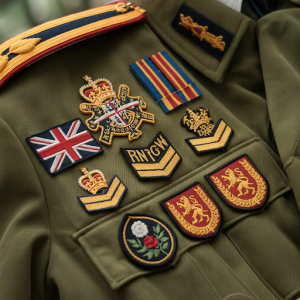
You might think they’re just stitched add-ons, but Battle Dress Uniform patches are the backbone of military identification. Every patch, whether it’s a standard flag, regiment insignia, rank badge, or mission tab, follows established placement and wear instructions.
Whether you’re in active service, designing reenactment uniforms, organising a military-themed event, or crafting custom patches for UK tactical brands, patch accuracy is everything.
That’s why working with the best patch maker, especially one who specialises in custom embroidered patches, custom PVC patches, and custom tactical patches, becomes crucial. Patch quality determines:
- durability in the field
- visibility and readability
- adherence to official standards
- that clean, sharp, squared-away look everyone respects
Because a fuzzy, cheap-looking patch? That’s how you get judged before you’ve even stood at ease.
A Quick Breakdown of Core BDU Patch Types
1. Identification Patches
The essentials: name tapes, branch tapes, rank patches. Nearly always placed front and centre, both literally and symbolically.
2. Unit Insignias
The iconic patches showing regiments, brigades, battalions, or specific task forces. These patches often follow strict sizing and colour guidelines.
3. Flag Patches
Typically worn on the arm. Some require Velcro, some require subdued colours, and some have very specific orientation rules. Yes, even the direction a flag patch faces has meaning.
4. Morale Patches
Slightly cheeky, sometimes humorous, often unofficial but widely accepted in many contexts. Morale patches boost camaraderie and personality without compromising professionalism.
5. Mission or Qualification Patches
Think airborne, medic, sniper, K9, engineer… these patches communicate skill and experience instantly. All of these come with their own rules, and BDU patch placement is a protocol-heavy game, not “stick it anywhere you fancy.”
BDU Patch Placement Rules (The UK Edition)
The placement depends heavily on the uniform system, but the principles remain consistent across branches. Here’s the basic breakdown:
The Chest Area
- Left chest: rank or identification tape
- Right chest: name tape
- Sometimes accompanied by a morale badge (context dependent)
The Sleeves
- Left sleeve: regiment/unit insignia or mission patch
- Right sleeve: flag patch or operation patch
- Velcro flag patch attach on OCPS or similar systems allow quick swapping in field operations
The Shoulders
Some tactical uniforms include shoulder Velcro areas for larger insignias or mission-specific identifiers.
Front Tabs or Centre Chest
Qualification tabs (airborne, sniper, ranger, etc.) and specialty patches. These follow strict width and height formatting. These placement rules are non-negotiable. They’re part of the identity, structure, and discipline that defines military dress.
If you want a deeper look into UK-tested, globally accepted layouts and patch types, Patch Makers UK has a brilliant breakdown here: Army OCP Patch Guide, Types & Placement for Military Uniforms.
The guide covers placement accuracy, magnetic vs Velcro use, and why uniform symmetry matters more than your morning coffee.
Why High-Quality BDU Patches Matter More Than Ever
Modern tactical gear sees more wear, weather, and repeated use than ever before. Outdoor conditions, field operations, training sessions, and frequent uniform washing mean cheap patches simply don’t survive.
High-quality custom embroidered patches, Custom PVC Patches, Custom Woven Patches, and custom uniform patches ensure:
- colours stay sharp
- stitching stays intact
- Velcro stays strong
- no fraying at the edges
- professional appearance at all times
Whether you’re ordering bulk custom patches for uniforms or designing one-off specialty patches, quality is the difference between “Looks sharp!” and “Your patch is peeling off, mate.”
BDU Patch Materials That Work Best
Even with placement rules sorted, choosing the right patch style is crucial.
Embroidered Patches
The classic, textured, durable, and ideal for regiment and rank badges.
PVC Patches
Ultra-tough, waterproof, and modern. Great for tactical gear, bags, and jackets.
Woven Patches
Perfect for small, high-detail insignias.
Sublimated Patches
Best for photo-realistic or complex imagery.
All of these can be backed with sew-on, heat-seal (custom iron on patches), adhesive, or Velcro, depending on the uniform system. For BDUs, Velcro is king, fast, rugged, and field-ready.
Understanding BDU Patch Protocols
There’s a real structure behind everything:
- Sizing rules ensure consistency
- Colour regulations enforce uniformity
- Patch layering dictates what goes where
- Operational roles determine which patches are authorised
- Branch-specific guidelines refine shape, border, and backing style
Whether you’re into custom patches Velcro, custom military patches UK, or looking for a custom patch maker near me, understanding these details ensures your uniform or tactical gear matches official standards perfectly.
Linking Patch Protocols to Tactical Patch Design
Understanding BDU patch rules is only half the battle. Knowing which patch styles, patch types, and backings work best for military-grade usage is the real win. This is where Patch Makers UK’s deep dive comes in handy: Custom Tactical Patch Maker | Military, Branding & More.
This guide breaks down tactical patch durability, backing choices, colour psychology, border styles, and the difference between patches meant for uniforms vs bags vs jackets vs training gear.
Because designing a tactical patch without understanding how it will be worn is like designing a badge for a jacket pocket… only to find out the jacket doesn’t have pockets.
How Much Do Custom BDU Patches Cost?
Ah yes, the question everyone whispers but refuses to ask out loud. Prices vary based on:
- patch size
- embroidery percentage
- patch backing (Velcro costs more than iron-on)
- colours used
- border style
- quantity (bulk = cheaper)
But Patch Makers UK offers Custom Patches at Low Prices, cheap custom patches with no minimum, fast quotes, and rush order custom patches UK when you need them ASAP.
FAQs
1. What side does the flag patch go on for BDUs?
Traditionally, the flag goes on the right sleeve, facing forward (stars toward the front). Velcro-backed patches are common for quick swaps.
2. Can I use iron-on patches on tactical uniforms?
For heavy-duty BDUs, Velcro or sew-on options are recommended. Iron-ons work for lighter gear but not always ideal for intense field use.
3. Are morale patches allowed on BDUs?
Yes, but only in designated Velcro areas and depending on unit or department rules.
4. What’s the best patch style for military uniforms?
Embroidered and PVC are the top choices for durability, colour clarity, and weather resistance.
5. Can I design my own BDU patch?
Absolutely. Patch Makers UK lets you design your custom patch, choose materials, backings, colours, and order in bulk or small runs.
6. What backing is best for BDU patches?
Velcro wins hands down, rugged, removable, fast, and required for many tactical patches.
7. How long do custom BDU patches last?
Quality-made patches last years, even under heavy use. Cheap patches unravel, fade, and lose grip, avoid them at all costs.
Ready to Sort Out Your BDU Patch Game?
If there’s one thing the British military, tactical teams, cadets, and security sectors agree on, it’s this: A uniform is only as sharp as its patches. Whether you need: regiment insignias, unit patches, rank badges, morale patches, or velcro tactical patches, you need a patch maker who understands BDU patch protocols inside out.
Patch Makers UK delivers military-grade quality, fast turnaround, precise stitching, correct sizing, durable Velcro, and designs worthy of representing your team. Ready to upgrade your uniform? Let’s get your custom BDU patches sorted today.