
The move to the Operational Camouflage Pattern (OCP) marked a huge transformation of the modern-day soldier’s uniform. No matter whether you are a new officer, an ardent non-commissioned officer, or simply an army aficionado, how you wear your military uniform speaks volumes about the level of your discipline.
There may come a day when you will be contemplating the exact location of heraldic pieces in your newly received OCP uniform, trying hard to remember what you have heard regarding the proper patch placement in the army. This is your one-stop guide on proper Army OCP patch placement.
Whether talking about primary unit insignia or flag patches, rules concerning their usage and positioning are stringent to a fault. These rules create an identity of soldiers who share common values, principles, and command systems regardless of their physical location on the battlefield.
After you learn all the details of OCP uniform patches placement, including correct alignment, space, and backing, you will feel like a real pro who knows everything about this subject. Follow our recommendations and make sure that there will not be a single spot left unattended on your impeccable OCP uniform.
The Official Guide to Army OCP Uniform Patch Placement Rules
As indicated by the British military, the multi-terrain pattern (MTP) calls for sewing official insignia on removable Velcro sleeve blanking plates instead of directly sewing on the garment.
In relation to their locations, the Union Flag needs to be placed tightly on the upper edge of the left sleeve plate, while the Tactical Recognition Flash (TRF) or formation badge is supposed to be sewn centrally on the right sleeve plate about 7.5 cm from the shoulder seam.
The central chest blanking plate houses the rank slide, and not more than two badges can fit onto one blanking plate. Always ensure that badges are placed centrally and at the correct position based on the relevant rules in ACP 1358 regulations.
Though the MTP is the recommended location for military patches UK, there are still a big number of reenactors and collectors, cadet organisations, and US military personnel stationed in the UK looking for OCP patches.
Have you ever wasted countless hours poring through an out-of-date military website trying to Google “where do patches go on OCP Army?”
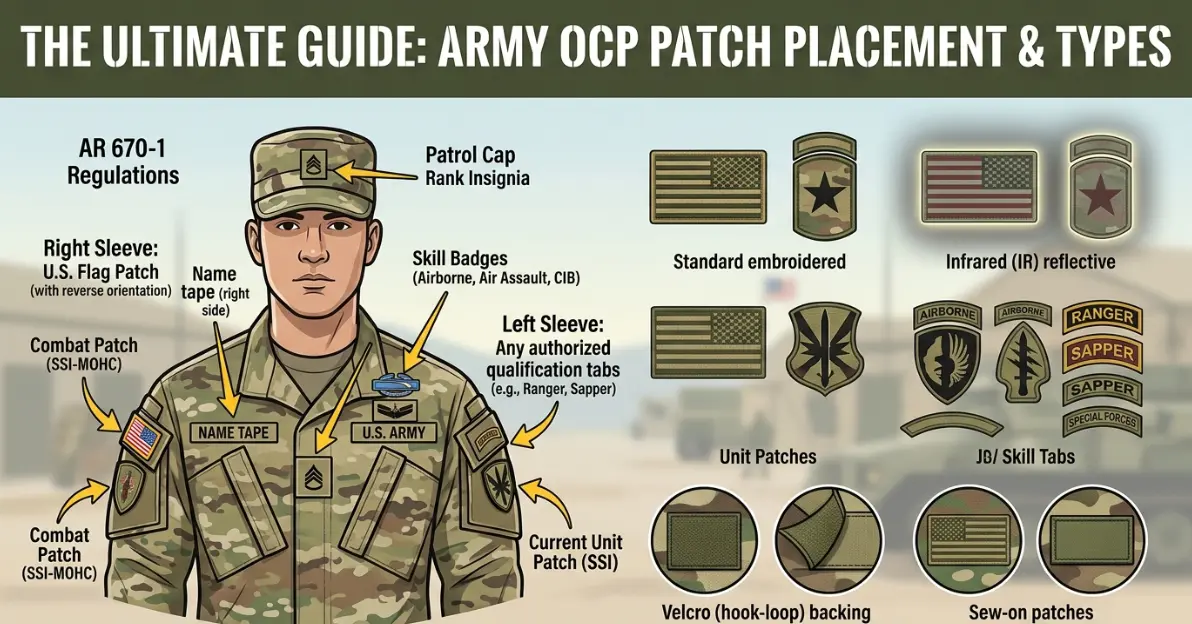
Understanding the geography of the sleeve and the chest of the uniform is essential for preserving high standards of appearance. The right shoulder sleeve is an honoured site and is reserved mainly for displaying the U.K. flag and battle patches.
The flag should be displayed in the reverse position, otherwise known as the “assault” position, creating the effect of the flag flapping in the wind as the soldier rushes headlong into the fight. This symbolic detail is a nonnegotiable aspect of Army OCP patch placement.
The left shoulder sleeve should have the unit patches of your current unit for identification. The Velcro strip here will hold the patch that signifies the current command you are in.
Above this, any special tabs such as those for the Rangers and Special Forces can be attached. On the front side of the uniform, the most important part of the body where identification can be found is the chest. The name tape, which should be in a color that blends well with the OCP uniform, should be pinned to the left chest.
On the right chest, the service tape that shows the unit as U.K. Army should be pinned. Finally, the rank insignia must be perfectly centered on the patrol cap, positioned exactly one and a half inches above the bill to ensure a professional silhouette.
OCP Patch Backing Types & Material: Sew-On, Iron-On, and Velcro Options
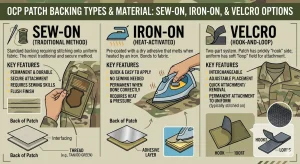
Even though knowing where each patch will be attached is crucial to the process, finding the right method of application is just as significant regarding the lifespan of your garment. Sew-on OCP patches are the favorite option for many servicemen due to their unbeatable reliability.
They are the most suitable patches when it comes to long-term garrison use because of the neatness and immovability that they offer. The problem is that sewing on patches requires maximum accuracy at the beginning since, once the thread is attached, you cannot undo it easily.
This method is often the preferred choice for army uniform patches placement on high-use items like combat jackets. On the other hand, individuals that are in need of a faster method should consider iron-on OCP patches, which can be useful when making preparations for a second uniform.
Although advances have been made regarding adhesives, iron-ons are normally not as durable for use in environments where high friction and high temperature occur, such as on the battlefields or in military washing machines.
In the case of custom iron on patches, special care should be taken with regard to temperature adjustments. As far as the modern tactical realm is concerned, Velcro-backed OCP patches are among the most preferred options owing to their exceptional modularity.
They facilitate the quick change of uniforms for various purposes or operations by enabling you to detach your name tapes and other markings prior to washing or putting on another outerwear item.
In order for your patches to look professional, it is important to acquire them from the best custom patch maker near me. The key indicators of high-quality embroidery patches include high-density stitching and reinforced edges, which prevent fraying in sunlight or rainy weather. Alternatively, PVC rubber patches are the best option for patches that survive every weather.
Achieving Precision: A Professional Approach to Alignment
The distinction between the “squared away” soldier and the one who looks unorganised often hinges on a few millimeters. In order for your OCP uniform patches to be properly placed, you need to measure carefully.
The rule regarding unit patches on shoulders says that you should always make sure that they are placed two inches down from the shoulder seam. In doing so, the members of a platoon will have identical uniforms, which is vital in ensuring unity.
In terms of the patches on the chest, you must align the edges of your name tape and service tape with those of the pocket flaps. Otherwise, you are at risk of being penalized during a formal inspection.
Finally, when talking about patches on the patrol cap, the most important aspect is centering. This patch must be placed exactly one and a half inches above the brim and not tilted in any direction.
Given the intricacy of the OCP design, it is better to rely on precise measurement with a ruler rather than “eyeball” this process. If you want to learn about the history of military patches and their purpose, check out our guide to Understanding Military Patches: Types, Meanings, and Purpose.
The Role of Custom Patches in Specialised Units and Veteran Organisations
Military patches can be understood in terms of the specialized divisions and lineages to which the soldiers belong. For those individuals from special division groups, ROTC cadets, or veterans clubs, custom military patches UK-made will offer a high-class approach for recognizing their unique accomplishments.
The custom embroidered OCP patches may feature unit insignias, special dates, or other unique identifiers that go beyond what is found on regular issues of patches. There is a technological aspect of patching, as well.
Night-vision reflective patches are absolutely necessary during night missions to enable your teammates to recognise each other with night vision goggles without being seen with the naked eye.
In addition, custom PVC OCP patches are gaining in popularity due to their weather-resistant properties and three-dimensional quality that allows them to be recognised through mud or dirt.
If you need a particular USA’s OCP Patch design made in record time, there is nothing better than finding a reliable custom patch maker.
Integrating Military Aesthetics with Civilian Gear
The pride and respect accorded to the Army OCP patch also spills into the civilian side of life for most veterans and tactical fans. Most people decide to wear their uniform elements, including patches on their clothing, in civilian areas as a means of staying connected with the military.
For example, when you are putting together your outfit, you can easily wear these OCP patches just as respectfully as you would at the post. A great way of doing this is by wearing Velcro-backed OCP patches. You can attach these OCP patches to gear bags, hoodies, and other military-related garments offered by brands such as TRU-SPEC.
For a more discrete look, most individuals tend to get custom PVC patches with subdued or monochromatic designs. In all cases, however, it is always important to go with high-quality embroidered patches made in UK to prevent fraying of edges.
Expanding the Playbook: Air Force OCP Patch Placement Explained
However, with the introduction of the Operational Camouflage Pattern among the Air Force, new guidelines have been introduced that follow those of the Army but still hold some unique specifications.
Learning the Air Force OCP patch placement will help Air Force personnel uphold the best possible standards of the armed forces. In terms of the sleeves, the left one holds the patch of the major command, whereas the right sleeve can accommodate the U.K. flag along with other patches of higher headquarters.
The chest tapes follow the typical military design, with the surname placed on the left and the designation “U.K. Air Force” on the right side. For the two-piece Air Force combat shirts, the guideline recommends the use of Velcro fields available on the shirts to attach patches to prevent damage to the moisture-wicking material when sewn through it.
For off-duty wear, it is common for many Air Force personnel to create their own custom logo patches for their military caps, flight bags or jackets.
The Art of the “Stack”: Decoding Army Skill Badges Placement
For those who have acquired specialised qualifications, the location of their skill badges is an extremely important topic. It does not matter whether the badge is a sniper tab, an airborne wing, or a combat medic badge.
These should be “stacked” based on certain seniority guidelines and spacing requirements. Normally, all of these types of badges should be sewn a quarter of an inch from the bottom of the name tape on the left chest pocket.
Should you possess multiple badges, the appropriate spacing between each of them would be half an inch, but no more than three badges per OCP uniform should be worn. Seniority order becomes crucial when determining what goes at the top of the stack.
However, if you wish to commemorate such a qualification in a different way, for example, by placing the patch on your veteran’s bomber jacket, there is also an option for making custom bullion patches.
These are obviously not meant for everyday duty uniforms but could serve perfectly well in shadow boxes as a heritage keepsake or a souvenir for your collection. Alternatively, if you wish for a more modern design, custom sequin patches or printed options will provide additional creative freedom for the custom insignia.
Resolving the Flag Orientation Debate: Why the Stars Face Forward
One of the most common inquiries made by those new to the Army OCP uniform is whether the flag on the right shoulder appears backward. The explanation of this phenomenon lies in examining the history of carrying the flag on the battlefield.
While in battle, as soldiers move forward and carry the flag, it will fly backwards. That means that the side of the flag with the pole should face the direction the soldier faces. This way, the bearer will always be moving forward and not backward.
In other words, if the flag is worn with its canton facing back, the soldier will appear to run away from battle. When wearing your U.K. flag patch, remember that there are no exceptions to this practice.
As soon as you place the flag patch on your Army OCP uniform, make sure that the forward rule was properly followed. It is a small detail that carries immense symbolic weight and is a hallmark of Army OCP patch placement accuracy.
Want to see how the game changed over time? Jump into the evolution of custom patches. From military to fashion, it is a real eye-opener.
Choosing the Right Manufacturer: Why Quality is Non-Negotiable
Whereas the placement of patches on your OCP uniform and projects is equally vital, the patch quality source is critical when you have decided to outfit your uniform. Patches made using inferior materials are prone to fading in a matter of weeks once exposed to sunlight and peeling off at the edges after the first wash.
This is why you ought to engage the UK#1 custom patch manufacturer, known for precision and durability. Patch Makers UK is a company specialising in providing various types of customised patches for military purposes, ranging from custom PVC patches for heavy-duty wear to traditional custom embroidered OCP patches for garrison uniforms.
The firm recognises your needs as a military unit and, therefore, provides fast turnaround custom patches UK services whenever required by the customer in bulk or low-minimum orders. Be it a name tape or unit identifier that you need for any military purpose, attention should be paid to density and backing.
Frequently Asked Questions
[faq_accordion]
Boom Your Uniform Standards with Patch Makers UK
Your patches are not just pieces of cloth but badges of your service and unit’s legacy, along with personal achievements and accomplishments. If they are well-placed on your OCP uniform, they speak a language of professionalism accepted by every branch of the military.
It only takes one misaligned unit insignia or a crooked rank insignia to make you look unprofessional, but with good advice and quality products, you can make sure you will never miss an inspection.
Patch Makers UK is here to provide you with the utmost accuracy and quality demanded by military personnel all over the world. Being UK#1 custom patch manufacturer, we offer you anything ranging from custom military patches UK to custom PVC patches and highly visible IR identifiers.
Whether you are in need of rush order custom patches UK for an imminent deployment or wish to create a unique tribute for your veteran organisation, Patch Makers UK is here for you.
We are familiar with the intricacies of placing the Army OCP patch placement and will be able to offer you some of the finest products out there. Do not waste your money on poor quality stitching when your uniform means much more. Call us now and start working on your order, as we are the best patch maker who offers perfection with each stitch.