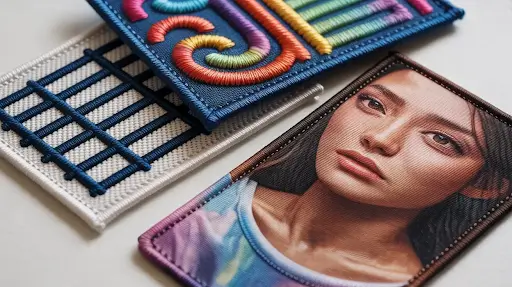
There’s nothing more heartbreaking than approving a patch design that looks razor-sharp on screen… only to receive the finished embroidery and realise your small text has turned into a fuzzy suggestion of letters. Not a typo. Not a machine fault. Just the brutal reality of embroidery physics.
If you’ve ever squinted at a badge thinking, “That was meant to say something, right?” , you’re not alone.
Small text is the silent killer of embroidered patches. But here’s the good news: woven or sublimated patches exist specifically to fix this problem, and when used properly, they’re absolute game-changers for branding, uniforms, events, and fashion.
Let’s break down why embroidery struggles with fine detail, when it still works, and exactly how woven or sublimated patches save the day, without wrecking your budget or your brand image.
The Hard Truth About Embroidery and Small Text
Embroidery is brilliant. Timeless. Premium. Rugged. But it’s not magic.
Embroidery works by stitching thick threads into fabric using needles that physically move up and down. That mechanical reality creates limitations, especially when text gets small.
Why Embroidery Struggles with Tiny Lettering
Here’s what actually goes wrong:
- Thread thickness: Embroidery threads are thicker than pixels or ink
- Needle penetration: The needle needs physical space to punch through fabric
- Pull and tension: Tight stitching causes letters to close up
- Fabric distortion: Small shapes lose definition as fabric shifts
Once text drops below around 5–6mm in height, embroidery starts to blur letters together. Serifs disappear. Spaces close. Counters fill in. Suddenly “EST. 1998” looks like modern art.
This isn’t about poor digitising or a bad patch maker, it’s simply the wrong technique for the job.
When Embroidery Still Works (And When It Doesn’t)
Embroidery still has its place.
Embroidery Works Best For
- Bold lettering
- Block fonts
- Large logos
- Simple shapes
- Classic crests and badges
- Custom military patches UK style
- Custom biker patches for jackets
Embroidery struggles with
- Fine text
- Thin fonts
- Small taglines
- Legal lines
- Website URLs
- Dense information
- Small custom logo patches for hats
If your design relies on clarity at a glance, especially at small sizes, embroidery may not be your best mate.
That’s where woven or sublimated patches step in.
Why Woven Patches Fix Small Text Problems
Woven patches use thin threads woven together on a loom, rather than stitched into fabric. Think of it like high-resolution fabric printing using thread.
What Makes Woven Patches Different
- Much finer threads
- No needle penetration into a base fabric
- Tighter weave density
- Sharper edges
- Clear letter separation
The result? Text that actually looks like text.
This is why woven patches are widely used for:
- Name patches
- Rank badges
- Event patches
- Club member patches
- Corporate logo patches UK made
- Custom employee name patches for workwear
If your design includes small letters, woven patches are often the best custom patches to order without redesigning everything.
For a deeper comparison between styles, this guide breaks it down nicely: Pick the Best: Embroidered vs Sublimation vs Woven Patch.
When Sublimated Patches Are the Ultimate Fix
If woven patches are sharp, sublimated patches are surgical.
Sublimation uses heat to permanently bond dye into the patch surface. No threads. No stitches. No distortion.
Why Sublimated Patches Handle Tiny Text Perfectly
- Text is printed, not stitched
- Zero thread thickness
- Unlimited colour detail
- Crisp edges at any size
- Photographic clarity
This makes sublimated patches ideal for:
- Micro text
- Fine outlines
- QR codes
- Colour gradients
- Multi-language designs
- Promotional patches for brand marketing
- Custom patches for events and festivals
If your patch includes information that must be readable, sublimation is often the safest choice.
Woven vs Sublimated Patches for Small Text
Let’s make this practical.
Choose Woven Patches When:
- You want a stitched look
- Text is small but not microscopic
- You want texture and depth
- The patch needs to feel premium
- You’re ordering bulk custom patches for uniforms
Choose Sublimated Patches When:
- Text is very small
- Colour accuracy matters
- You want photo-level detail
- The design is complex
- You need fast turnaround custom patches UK
Both options massively outperform embroidery for fine detail.
Common Design Mistakes That Kill Small Text
Even with woven or sublimated patches, bad design choices can still trip you up.
Avoid these classic errors:
- Ultra-thin fonts
- Script fonts at small sizes
- Low contrast colour combos
- Cramming too much text into one patch
- Ignoring viewing distance
- Designing for screen, not fabric
A solid custom patch maker will flag these issues before production, which is why working with the best patch maker in the UK actually saves money long-term.
How to Fix Small Text Without Redesigning Everything
Good news, you don’t always need a full redesign.
Here are smart fixes that work:
- Switch embroidery to woven patches
- Convert micro text to sublimation
- Increase text size slightly
- Boost contrast
- Separate text into a secondary patch
- Use backing options that stabilise detail
If you’re unsure how a patch will sit on clothing, this article is a solid reference: Get Custom Design Patches to Match Any Outfit or Style.
Best Backing Options for Fine Detail Patches
The backing matters more than most people realise.
For small text clarity:
- Heat seal backing keeps edges flat
- Sew-on backing offers flexibility
- Velcro backing works well for uniforms and tactical use
Avoid cheap adhesives that can warp the patch over time, especially for sublimated patches.
Cost Comparison for Small Text Patches
Let’s talk numbers, because everyone asks.
Typical Pricing Factors
- Patch type
- Size
- Quantity
- Backing choice
- Turnaround speed
Generally speaking:
- Woven patches cost slightly more than embroidery
- Sublimated patches are often cheaper for complex designs
- Bulk orders reduce cost per unit dramatically
- Cheap custom patches with no minimum are possible with the right setup
If you’re asking how much do custom patches cost, the answer depends on choosing the right technique first, not fixing mistakes later.
FAQs
Why does small text look bad on embroidered patches?
Embroidery uses thick thread and needle penetration, which causes small letters to merge and lose definition.
What is the minimum readable text size for embroidery?
Around 5–6mm tall. Anything smaller risks clarity issues.
Are woven patches better than embroidered patches?
For small text and fine detail, yes. Woven patches offer higher resolution and sharper lettering.
Do sublimated patches last as long as embroidered ones?
Yes, when produced correctly. Sublimated patches are colourfast and durable for regular wear.
Which patch type is best for logos with small writing?
Woven or sublimated patches are usually the best choice.
Can I mix patch types in one order?
Absolutely. Many brands use embroidery for bold logos and woven or sublimated patches for detail work.
Why This Choice Matters!
Your patch is often the first thing people notice. It represents your brand, your club, your event, or your identity. Letting small text fail because of the wrong production method is an avoidable mistake and an expensive one.
If clarity matters, embroidery isn’t always the hero. Woven or sublimated patches exist for a reason, and using them properly separates professional branding from amateur disappointment.
If you’re planning to buy custom patches online, ordering bulk patches, or launching a branded range, get the technique right from day one. The difference isn’t subtle, it’s night and day. Small text doesn’t have to fail. You just need the right patch from Patch Makers UK to back it up.