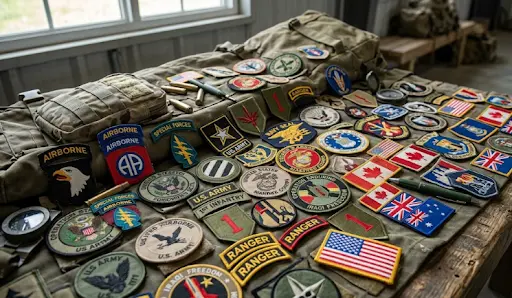
Every single thread that forms a military uniform holds a story within its depths of valour, loyalty, and history. It represents sacrifices and courage along with the additional representation of rankings in the military.
Soldiers for generations have donned this humble yet meticulously crafted artefact called “military patches,” which represent a unit’s identity and the battles it has fought through.
When one holds this piece of history in his hands, one is indeed holding something special. For those interested, our guide below sheds light on how to identify military patches.
How to Identify Military Patches
The art of recognising military patches goes far beyond merely looking at a colourful design. It requires a deep appreciation for military heritage and a keen eye for manufacturing details.
From all the significant wars that occurred throughout the twentieth century, the need for fast identification of soldiers on the battlefield resulted in the creation of thousands of different custom military patch designs for divisions and brigades.
Thus, nowadays we have a great number of patches for military personnel to explore and classify. By analysing their history, one can get an insight into changes in the army through decades.
Identify Military Patches with Uniform Positioning and Placement Protocols
Within the ranks of the British military services, there is never an element of coincidence about the positioning of a particular military patch on any uniform garment. This is because of the rigidly observed rules on uniform etiquette.
For instance, when looking at a modern British Army combat uniform, the upper arms are the most critical zones to observe. The right sleeve conventionally displays the Union Flag alongside specific Tactical Recognition Flashes (TRFs), which are small, distinct colour blocks unique to individual regiments or corps.
Just below these, you will often find larger formation signs indicating the specific brigade or division. Conversely, an individual’s rank insignia, such as sergeant stripes or an officer’s rank slides, are worn centrally on a single chest strap in modern working dress, shifting away from the traditional shoulder epaulettes of older eras.
By noting exactly where a military patch is attached to a garment, you can immediately categorise whether it represents an overarching command structure, a specialised trade qualification, or the personal rank of the wearer.
The Masterclass on Identifying Military Patches
If you have recently acquired a collection of military patches or found a solitary morale patch in a vintage shop, your primary goal will naturally revolve around understanding its origins. Learning how to identify military patches is a process that blends historical research with tactile examination.
The first thing you need to do is analyse the general shape of the emblem. Infantry units typically made use of relatively simple geometrical shapes like circles, triangles, or shields, which would be easy to identify even from afar.
Having analysed the shape of your emblem, you now need to examine its core element. For example, animals, mythological creatures, swords, and lightning bolts have often been used to reflect special qualities and geographical locations of the units.
An eagle symbolising airborne units and an anchor indicating a naval unit are good examples of this. Having correlated your information with historical military databases, you will be able to estimate the period and the location in which the patch was used.
Analysing Craftsmanship and Merrowed Borders to Identify Military Patches
There is one detail about military patches that will tell you more than anything about their origins. An enthusiast will be able to gauge roughly how old the piece he is holding is just by running his thumb along the edge of the patch.
It is easy to identify the period when it was made based on the type of edge it had. The patches created during the mid-century times and later tend to have merrowed borders that have an extremely dense overlock stitched around them to prevent fraying and give the emblem some texture and longevity.
On the other hand, the vintage patches from WWII tend to have a cut edge where the design was embroidered onto a larger roll of twill fabric and then simply sliced out, leaving a flat, sometimes slightly frayed border. By closely examining these manufacturing hallmarks, you can confidently separate antique originals from modern reproductions.
Inspecting Digitising and Embroidered Military Patches
Beyond the borders, the density and direction of the thread itself offer vital clues. One should take these into account, as embroidered military patches are very technical works of art.
Modern military patches are embroidered with the help of highly developed computer digitising programs that instruct high-speed computerised sewing machines to lay down thousands of stitches with flawless geometric precision.
It leads to dense, uniform colour blocks and readable text. However, earlier military patches were made on sewing machines controlled by human hands or even on primitive automatic looms.
The use of those older machines led to irregularities in stitching the pattern, which are commonly known as “snow,” as small parts of the underlining fabric are visible between the upper layer of threads. Noticing such imperfections helps in the military patches identification.
Material Evolution and Modern Synthetics in Military Patches
The materials in military patches have been greatly refined over time as new technologies and equipment have been developed. In the past, the main material for patches was either cotton or wool because of their accessibility and traditional appearance.
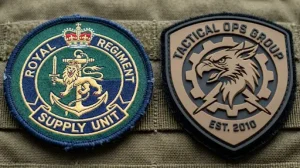
Unfortunately, natural fabrics such as these could not withstand harsh conditions and tended to deteriorate rapidly. The present-day situation is radically different. While embroidered/woven thread is still very popular. Many of the more advanced units have begun to use completely different manufacturing processes for tactical patches.
The most common of these is 3D PVC patches. These modern rubbery materials are water-resistant, extremely durable, and can produce a high amount of detail, much higher than woven thread patches could achieve.
The type of material used in the production of the military patch immediately tells us how old the patch is. A patch made from woven or embroidered soft cotton twill was created many years ago, whereas a flexible PVC patch points directly to contemporary service.
Decoding Colour Palettes in Vintage Army Patches
Colour is arguably one of the most immediate indicators of a patch’s purpose and era. When sorting through vintage army patches, you will quickly notice a stark division between full-colour designs and subdued variants.
Full-coloured patches that had rich reds, deep blues, and bright golds were mostly used for the purpose of being worn in dress uniforms or for a time before camouflage and stealth were essential aspects of warfare.
However, as technology advanced, especially in the era of the Vietnam War and other battles fought in the Middle East, the need for bright colours in uniform patches proved perilous for soldiers.
Hence, the development of subdued patches came about due to their use of dull colours such as olive drab, brown, and black. From your evaluation of how bright or subdued the colours of the customised military patch are, you can effectively tell what environment the patch was supposed to be worn in.
Distinguishing Camouflage Adaptations in Modern Military Patches
While looking for modern military patches, the study of their background materials and thread compatibility is as important as decoding their central symbols. In contemporary military logistics, military patches are carefully designed to match specific national camouflages so as not to reveal soldiers in disguise.
While researching British military gear, one often finds military uniforms with MTP (Multi-Terrain Pattern) patches. These British-made military patches are designed according to the unique colour combination of soft greens, light tans, and earthy browns, reflecting British camouflages that provide concealment in multiple environments.
On the other hand, American gear will be marked with military patches meant for OCP (Operational Camouflage Pattern) uniforms and have separate placement rules. Both of the camouflages aim to blend the personnel into the environment, but OCP uses a little bit different pattern geometry and a greater portion of specific foliage and sandy colours.
Understanding the difference between MTP and OCP fabric materials is important since it makes it easier for researchers to determine the nationality of contemporary military patches.
How to Identify Military Patches with Reverse Side and Hook-and-Loop Backings
The first-time collector gets so fascinated by the front part of the item that he fails to notice how many clues there could be at the back of the patch. Always turn the patch around because what lies behind it serves as the timeline of technological development for manufacturers.
If the patches were made in the very early twentieth century, you may find that they had raw threads sewn on the backing of cheesecloth or raw buckram. In the following decades, manufacturers used to add a layer of plastic or heat-sealing agent to the back of the patch to make it possible for soldiers to iron on patches onto their military uniforms.
In today’s modern armed forces, convenience and modularity are key. Consequently, almost all authentic tactical patches issued today feature robust Velcro hook and loop backings. This allows service personnel to instantly swap out their unit identifiers, morale indicators, and medical information depending on the specific requirements of their mission.
The Passion Behind Collecting Military Patches
The pursuit of these historical artefacts is far more than a simple pastime. It represents a noble cause to keep the memories of these fallen soldiers alive. There are plenty of historians, military veterans, and archivists within the community who share a common passion for preserving these little pieces of history.
Being part of the community may just be the best way for one to develop his or her identification skills. Being active in collecting forums and military museums, as well as being part of collecting military memorabilia fairs, will allow one to collaborate with fellow members to determine whether a particular item is indeed genuine.
These types of collaboration will help one keep the memories associated with a certain patch intact. For example, when one traces a beautifully embroidered and cut-edge military patch to the particular squadron that once flew over Europe many years back, then it means that one is helping in immortalising the memory of that squadron.
Crafting the Future of Tactical Military Patches
Although the process of identifying vintage items can be fascinating, the designing of new military patches plays a significant role for those currently serving and the private companies. Never before has there been a higher requirement for quality identifiers.
Whether you need high-visibility clothing as a contemporary security company or want to create exact copies of WWII insignias for your history group, the basic design principles stay at the core of the process.
Transforming a sophisticated computer image into a sturdy and durable patch made out of fabric or PVC relies on an acute knowledge of how to control threads, backings, and borders. It is a very detailed procedure that results in a perfectly clear patch able to endure heavy wear.
Frequently Asked Questions
What is the most reliable method for authenticating a vintage military patch?
The authentication process for an old item requires analysing multiple physical characteristics, including the thread material, which should be natural like cotton, and examining the fabric’s rear for raw backing, such as buckram or cheesecloth, rather than synthetic options.
Can the type of border stitching determine the exact era of a patch?
The style of a patch’s border aids in dating its production. Flat, frayed edges indicate World War II or earlier, while thicker merrowed edges emerged post-war. Modern patches often feature laser-cut borders, particularly in tactical emblems.
Why are modern tactical patches transitioning to PVC instead of traditional thread?
The transition to PVC is driven by contemporary military conditions. While embroidered emblems are visually appealing, they deteriorate when exposed to elements. PVC offers a flexible, durable, and water-resistant solution that can be easily cleaned after use.
How should I preserve my collection of regimental cloth patches?
Preserving vintage textiles requires clean or gloved hands to prevent deterioration. Store them in temperature-controlled areas with minimal sunlight exposure, as light can fade colors. Utilise acid-free shadow boxes or sleeves for optimal display and protection.
Elevate Your Custom Military Patch Collection with Patch Makers UK
Done reading our guide on how to identify military patches? For those of you who are committed historians and would like to recreate a historic military patch for your display, or if you are from one of the many service units that need tough and durable equipment. Patch Makers UK is your destination.
We have a comprehensive understanding of the significance each patch carries, and we put in all the experience we have garnered in decades in our work of manufacturing custom patches for you.From the timeless thread designs with the traditional merrowed edging to the durable PVC design with its hook and loop system, there is no end to customisation here. If you feel that you have your own vision for your very own custom military patches UK, then get in touch with our design team right away.